
How the Grateful Dead’s first show in San Jose helped spark Silicon Valley’s rise
November 28, 2025 Silicon Valley Business Journal
Imagine there was no Silicon Valley.
I don’t mean the place. But rather, what if Santa Clara County never became what we know it as today? What if the personal computer wasn’t invented in a garage in Cupertino, but instead an MIT laboratory in Boston?
It seems far-fetched to think of today but save for one night in early December 1965 that could have been reality.
Feed your head
There has long been a connection between the counterculture movement of San Francisco in the 1960s and the high-tech industry that developed further down the Peninsula in the 1970s.
In “What the Dormouse Said,” tech author John Markoff explored the connection between the counterculture and the nascent computer industry. In that book, he said it was not uncommon for early Silicon Valley engineers to use LSD. This usage led them to envision a future world with computers.
Even Steve Jobs was known to have taken LSD in the early days of Apple Computer. He is quoted in a New Yorker article as saying, “LSD shows you that there’s another side to the coin.”
Acid test
On the East Coast psychology professor Timothy Leary had been experimenting with LSD since the late 1950s. In California, LSD’s major proponent was “One Flew Over the Cuckoo’s Nest” author Ken Kesey.
He had begun hosting parties at his La Honda ranch where LSD was freely available to invitees (LSD was not made illegal until 1966 in California). A local band from Palo Alto/Menlo Park was the house band that provided the soundtrack to those parties.
After returning from a cross-country tour in a converted school bus, Kesey decided to unleash LSD on the masses. He planned to take his parties public and dubbed them “acid tests.”
The first was planned for Dec. 4, 1965, in San Jose. The Rolling Stones were performing at the San Jose Civic Auditorium on that cool, clear Saturday when Kesey triggered what would become a seismic shift in both music and tech culture.
The bus came by and I got on
Just days before, Kesey’s house band changed their name from the Warlocks to the Grateful Dead after bassist Phil Lesh noted there were already two other bands named Warlocks.
That first party was held at 38 S. 5th St. where City Hall now stands.
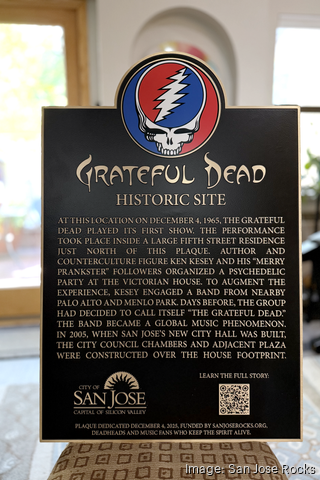
San Jose Rocks
This Dec. 4, the city will commemorate the first time the band performed publicly as the Grateful Dead with a plaque installed outside the City Council chambers. The placement of the plaque is significant because it will hang roughly where the house they played in used to stand.
For the last 15 years San Jose Rocks founder Dan Orloff and retired journalist Mark Purdy have been researching that night. Digging through archives with help from Gary Singh from the Metro, they eventually confirmed the location of that first show.
“It came to our attention that the house, which was relocated … to make way for City Hall, was torched in an arson fire,” Orloff said. For years everyone assumed it had burned down.
Their research uncovered that the house was refurbished after the fire and eventually moved from 5th Street to 390 N. 4th St. More importantly, they were able to confirm that the house had stood on land that is now under the City Council chambers.
True innovators
The house band that became the Grateful Dead was a musical innovator. They blended jazz, bluegrass and rock and helped create the psychedelic music movement. They were also business innovators.
The band’s approach to business was “basically as improvisational as their music,” said Dennis McNally, longtime band biographer and publicist.
“They spent over a million dollars on what became known as the Wall of Sound,” McNally said. This was at a time when touring bands relied on the local promoter to secure the sound system.
“They got tired of complaining,” McNally said. “So, … they brought it in-house.”
Another aspect of touring that they “brought in-house” was ticket sales. “They brought ticketing in-house. Again, a business decision that was conscious,” McNally said.
That decision eventually led to a fight with ticket sales companies. In the early 1990s the band went after TicketMaster — in 1991 TicketMaster had a near monopoly on concert ticket sales. The band wanted to maintain the 50/50 split on ticket inventory and TicketMaster wanted a 90/10 split.
The Grateful Dead Ticketing Service had been in place since the early 1980s and the band’s agreements with the venues predated the establishment of the large ticket agencies like TicketMaster.
According to McNally the Dead’s lawyer had a meeting with TicketMaster where he told them, “Grateful Dead has had relationships with these box offices, you know, long before you existed.”
In the end the band was grandfathered in and allowed to keep the deals that had worked for over a decade at that point.
This direct sales method meant that by the time the buses left Marin County they had sold out most of their tour dates.
“We did sell a lot of tickets, and that’s a fact,” McNally said. “I might add, we were consciously selling tickets at a slightly lower price than we could have, a lot lower than we could have, because we wanted to give our audience a break.”
Another blow to music industry standards was the allowing of taping of shows.
“They did it because the tapers had been setting up in front of the sound mixer,” McNally added.
“To be able to prevent taping, you would have to ruin the ambience of the show,” McNally said. “And you know, they were lousy cops.”
They eventually sold tickets to a separate ‘tapers section’ behind the sound mixer.
Jerry Garcia, singer and guitarist for the Dead, famously quipped that once they were done with it the fans could have it.
What a long, strange trip it’s been
Orloff mused, “if not for LSD, … would we even have a Silicon Valley?”
While that is a concept that would be impossible to test, it’s one Markoff posits in his book. And if we accept that conceit then we could argue that Dec. 4, 1965, in San Jose a little known band and their followers were really the start of Silicon Valley.
It has been said that the Grateful Dead were not the best at what they did — they were the only ones doing what they did. And that applied to how they ran their business as well.
In 1994, their final year of touring before Garcia’s death in 1995 they pulled in around $50 million from ticket sales, $35 million in merchandise sales across all outlets and only $5 to $10 million in album sales. Total gross for that year was $95 million.
Not bad for a band that eschewed cultural norms and struck out on their own journey just like the tech pioneers of the Valley of Heart’s Delight.