
It took nearly 10 years of work on the road to unlimited devotion. But the San Jose Rocks project to mark the site of the first Grateful Dead show in history finally reached fruition on December 4, 2025.
In a sundown ceremony attended by hundreds of Deadheads and music lovers, a plaque was dedicated on San Jose City Hall’s south plaza to permanently honor the location of the Dead’s initial performance under that name.
The dedication took place on the exact 60th anniversary of that historic event, which took place in a Victorian house that once stood at 38 South Fifth Street. The home’s footprint is now covered by the Janet Gray Hayes Rotunda adjacent to San Jose’s City Council Chambers and the adjacent plaza.
Funds for the plaque and the ceremony were donated by fans from around the world. City council members, San Jose Mayor Matt Mahan, and Vice Mayor Pam Foley, added their support.
“Grateful Dead didn’t just start here,” Mahan said in his remarks to the crowd. “They launched a cultural movement that spread from San Jose across the world. This plaque is a tribute to where that energy began.”
The scene that Mahan addressed was a tribute to the vast constituency of that energy. Tie-dyed tee shirts mixed with city staff employees, college students, septuagenarians, music lovers, and Deadheads who had traveled from as far away as New Hampshire and Ohio to attend the plaque unveiling.
The festivities were hosted by KCBS Radio personality Kim Vestal. She introduced speakers such as Ira Meltzer, who shared his in-person account from the crazy night of December 4, 1965, when author Ken Kesey and his “Merry Prankster” followers organized their first public “Acid Test” with LSD and invited the newly-named Grateful Dead to provide the musical accompaniment.
“I showed them where to plug in,” said Meltzer, who was friends with the occupants of 38 South Fifth and played a part in organizing the gig.
And so it was that Jerry Garcia, Bob Weir, Phil Lesh, Ron “Pigpen” McKernan and Bill Kreutzmann launched their long, strange trip. Jerry Garcia’s daughter, Trixie, also spoke at the plaque ceremony and put it in context.
“The ’60s changed the world,” she said. “And what was started here in the Bay Area continues to lead the world and progressive thought and a more mindful way to exist.”
Trixie Garcia then assisted San Jose Rocks founder Dan Orloff in undraping the plaque The crowd then spilled out across the plaza to visually take in a massive light show that was projected onto the City Hall tower and dome. The light show was accompanied by live songs from a San Jose State University jam band and by Grateful Dead recordings. Inside the dome, a reception featured artifacts from 1965 including an original hand-drawn poster from the December 4 “Acid Test.”
As fate would have it, the 60th anniversary plaque celebration took place just five weeks before the death of Bob Weir, who knew about the plaque project and supported the idea but was unable to attend the December 4 commemoration due to his health issues. Bill Kreutzmann, the other surviving band member from December 4, 1965, seldom leaves his home in Hawaii.
The San Jose City Hall event was the capstone of a decade-long quest by Orloff and his team to honor a significant moment in San Jose cultural history.
The event was the capstone of a decade-long quest by Orloff and his team to honor a significant moment in San Jose cultural history.
“For us, this plaque isn’t just about Grateful Dead,” Orloff said. “It’s about celebrating the deep musical roots of this city – and passing those stories on to the next generation.”
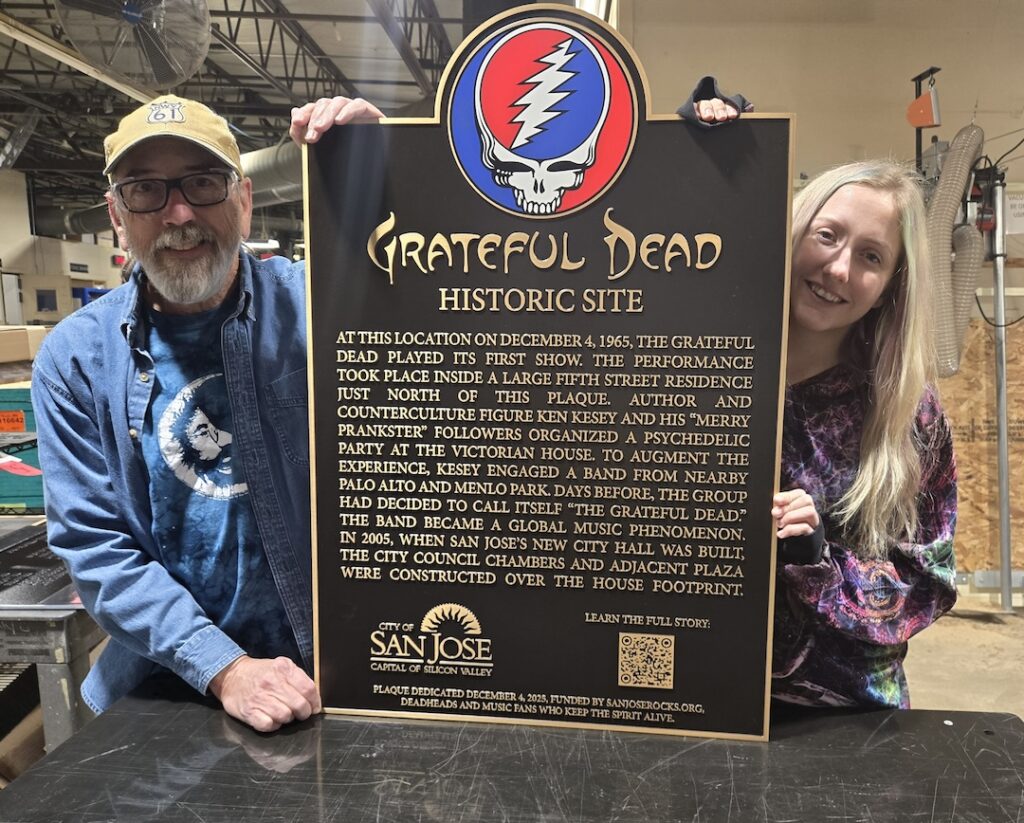
A shoutout to the team at Impact! Signs for the production of this awesome plaque!
Pinning down those stories, however, is often not easy. That was certainly true in the case of December 4, 1965. The journey of how it all came together for Orloff and his chief researcher, journalist Mark Purdy, included many twists and turns.
Want details? Scroll down. And read on.
Related News
San Jose Spotlight: Editorial: What a long strange trip it’s been for San Jose
Mercury News: San Jose stakes claim as home of 1st official Grateful Dead concert
SF Chronicle: The Grateful Dead’s real hometown? San Jose says it wasn’t San Francisco
Metro: Zero to 60: San Jose Marks Grateful Dead Birthplace
SV Business Journal: How Grateful Dead’s 1st Show in San Jose Sparked Silicon Valley’s Rise
Television
KPIX CBS Bay Area: Plaque unveiled marking San Jose location of 1st Grateful Dead concert
KRON 4: San Jose marks first Grateful Dead show with plaque unveiling
KTVU: San Jose Pays Tribute to Grateful Dead's 1st Performance Dec 4, 1965
A World of Thanks
Grateful Dead 60th Anniversary Plaque Dedication Ceremony
Stanley Mouse Commemorative Prints Still Available
Donors to the Grateful Dead plaque project received something truly special: a limited-edition handbill or print created by legendary poster artist Stanley Mouse. Mouse, known for his iconic concert posters from the Fillmore and Winterland—including Grateful Dead’s skeleton-and-roses imagery—was commissioned to design a commemorative poster celebrating the Dead’s debut at Ken Kesey’s Acid Test near San Jose State on December 4, 1965.
A small supply of the posters, plus the handbill version of Mouse’s artwork, is still available. They can be purchased to support the non-profit mission of San Jose Rocks. The posters will be mailed in a tube and insured. For information on how to order, click this link.

$50 Tax Deductible Donation
Supporters who donate $50 will receive a handbill version of Mouse’s print, much like the handbills that were passed out at those 60’s ballroom shows.
$200 Tax Deductible Donation
Supporters who donate $200 will receive a Stanley Mouse commemorative print, mailed in a tube and insured.
$500 Tax Deductible Donation
Supporters who donate $500 or more will receive a print inscribed by Stanley Mouse (mailed in a tube and insured) and special recognition at the unveiling ceremony.
Here’s How to Donate:
If you’d rather go old school and mail in your donation, please write a check to: San Jose Rocks, PO Box 18187, San Jose CA 95118-9998
Donations are fully tax-deductible—minus the fair market value of any goods or services received. Full details are available on our donation page.
Donors & Sponsors
We could not have completed our mission to honor this significant moment in music and Bay Area history without the significant support of donors who helped make it happen. Here’s the list. If you see any of them on the street, please thank them and remind them that because of their generosity, there’s nothing else to do but smile, smile, smile.
Click to expand and view donors.
Feature Stories by Bay Area Babylon
Special thanks to Lucky at Bay Area Babylon for these videos—be sure to explore the hundreds of stories he's chronicled about the Bay Area's incredible music connections on his YouTube channel.
The Fascinating Details Of How San Jose Became Dead First in Rock History
December 4, 1965, stands as one of the most significant dates in rock history. And South Fifth Street in San Jose holds the distinction of being the birthplace for the Grateful Dead’s unparalleled journey.
That evening, author and LSD enthusiast Ken Kesey hosted his first public “Acid Test” at the house, creating a vibrant, surreal experience amplified by music from the Grateful Dead, who had recently renamed themselves from “The Warlocks.”

In the decades since, the event has been cited as a launching pad for the psychedelic era of the late 1960s–as well as a template for the evolution of rock and roll concerts from mere stage shows into “experiences” accompanied by light shows and artist/audience interaction.
Who said that? Jerry Garcia said that.
“The Acid Test was the prototype for our whole basic trip. But nothing has ever come up to the level of the way the Acid Test was. It’s just never been equaled, really, or the basic hit of it never developed out. What happened was light shows and rock and roll came out of it, and that’s like the thing that we’ve seen go out.”
–Jerry Garcia, Rolling Stone Magazine, 1972
Kesey, who had conducted a preliminary “Acid Test” at a home in the Santa Cruz Mountains a week earlier, decided to expand his LSD evangelism. He prevailed upon friends who lived near the San Jose State campus to open their house to him for a Saturday night party–and strategically scheduled it to coincide with a concert by the Rolling Stones at the San Jose Civic Auditorium, located just blocks away.
Kesey and his band of “Merry Prankster” followers seized the opportunity. They created 700 handwritten flyers and posters advertising the Acid Test at 38 South Fifth, then stood on the sidewalk outside the auditorium and handed out the flyers to exiting concertgoers.
Meanwhile, other Pranksters rode in Kesey’s brightly colored “Further” school bus to the Fifth Street house. They piled out and began “decorating” the building with blinking lights and tape players and microphones that plugged into an echo machine. Kesey also wanted live music at his party. He asked the newly-named Dead to perform in a front room of the home. Their music interweaved with the energy of the flamboyant, costume-clad crowd.
“We had already played all those shows as the Warlocks,” Kruetzmann wrote. “But this was the start of something new, something different. It was bigger than itself for the first time . . . . It was a psychedelic circus and everyone was the sideshow and everyone was the main event.”
Lesh remembered even more details.
“Unfortunately, the room was very small, so all the attendees were crammed into the same space as the band,” Lesh wrote. “The crush of bodies together with the wind-tunnel sound and flashing projections turned the Test into a mind-numbing blur of noise, light, and heat. Thetapeloop master control was in Prankster hands; this ran a series of very long delays through a Mobius-strip speaker setup, with speakers in all corners of the room, receiving input from microphones and other mixers scattered everywhere.”
Amidst the chaos, the band somehow managed to crank out a loud batch of tunes from its early repertoire including “Mountain Dew” and “Good Loving.” The music and the crowd both spilled out onto Fifth Street. Some people thought it was just another wild fraternity party. Others realized something different was going on. After the Grateful Dead finished its set, the Acid Test raged on until 3 a.m., as Kesey led discussions about what each participant was experiencing under the influence of LSD, then a legal drug.
In a side note, Rolling Stones bassist Bill Wyman later recalled the night in his autobiography and hinted that Stones guitarists Keith Richards and Brian Jones briefly stopped by the Acid Test. The tale could be apocryphal. Richards has said he has no memory of being there. Jones passed away in 1969.
There’s no dispute, however, that the Dead band members knew that the Stones were performing nearby. Two teenaged sisters who were friends of Bob Weir – one of whom took guitar lessons from him in Palo Alto – say that Weir encouraged them to attend the Acid Test on December 4 because “the Rolling Stones might be there.”
The sisters, who chose to remain anonymous in a 2024 interview, say that was enough to lure them to South Fifth Street. They didn’t stay long. But they managed to keep a souvenir of the evening by pulling one of the crayon-scrawled Acid Test posters down from a telephone pole. They saved the poster for almost six decades before putting it up for auction. A collector paid $35,000 for it.

It is also clear that the Grateful Dead band members were not strangers to downtown San Jose. Although the group is usually associated with San Francisco’s Haight-Ashbury district, the band’s roots trace back to the South Bay, where their musical oeuvre began to take shape.
A Brief Timeline:
- Summer 1962: Jerry Garcia is frequently seen at Swain’s Music Store in Palo Alto, buying supplies for his growing passion for guitar. He performs at local venues, including St. Michael’s Alley, a bohemian hub that also launched Joan Baez’s career.
- May 1963: Garcia and his wife Sara perform at the Top of the Tangent in Palo Alto, where Garcia’s bluegrass music gained traction. It is that a teenaged Bob Weir from nearby Menlo Park first witnesses Garcia playing a guitar.
- Autumn 1963: Garcia, Weir, and Ron “Pigpen” McKernan decide to form “Mother McCree’s Uptown Jug Champions,” a rootsy band that performs regularly at The Offstage Folk Theatre on South First Street in San Jose. The venue becomes a counterculture haven for other rising Bay Area talents such as Janis Joplin, Jorma Kaukonen and Paul Kantner. The Offstage is a dingy coffee house with burlap walls and just 50 seats. But it’s a welcoming spot for an emerging counterculture. Garcia and his friends even take a bus trip to a San Jose State football game at the University of Oregon because a “hootenanny battle” is scheduled there the same weekend. The Jug Champions have a revolving lineup that can get fractious, according to Offstage proprietor Paul Foster. “But it was always Garcia who would patch up the ego spats and persuade them back together,” Foster writes in his memoir, describing the future Dead guitarist as “incessantly driven” and “master of warm heartfelt moodiness with a towering intellect.”

- Spring 1965: The Uptown Jug Champions morph into a harder-rocking group called The Warlocks, joined by Palo Alto musician Bill Kreutzmann on drums and College Of San Mateo student Phil Lesh on bass. They play their first gig at Magoo’s Pizza Parlor in Menlo Park and develop a strong following on the Peninsula and in the South Bay.
- November 1965: After being informed that another group on the East Coast has a claim to the Warlocks name, the band needs a new moniker. Jerry Garcia comes up with “The Grateful Dead” after he sees the phrase in a dictionary at Phil Lesh’s house in Berkeley. Band members have also become friends with Ken Kesey, a former Palo Alto neighbor who has moved to La Honda in the Santa Cruz Mountains while gathering a following of “Merry Pranksters” to spread the gospel of LSD, then a legal hallucinogen.
- December 4, 1965: After an initial Acid Test at a private home outside Santa Cruz, Kesey decides to hold a public version of the event at a house near San Jose State University and asks his friends to perform. The Grateful Dead play their first musical notes under that name in a house on South Fifth Street, launching their legend as pioneers of the psychedelic rock movement.
Uncovering The True And Exact Location Of The First Grateful Dead Show In History – And Where To Visit It
Pinning down the precise house and site of the Grateful Dead’s launching pad was never as simple a task as you’d imagine.
Several written accounts exist of the Acid Test party that took place on December 4, 1965, in downtown San Jose. The accounts focus on the event’s wild nature and colorful loud atmosphere. None of the accounts mention a specific address. None even describe the house in much detail. That’s’ what San Jose Mercury News journalist Mark Purdy discovered in 2008 while researching a story about the South Bay’s often-unsung role in Bay Area rock and roll history.
Purdy had first read about Kesey and San Jose’s connections to the Dead in author Tom Wolfe’s best-selling book, “The Electric Kool Aid Acid Test.” As Purdy pursued information about the event’s location, he was contacted by Ron Cook, a well-known Santa Cruz luthier and instrument craftsman. About – Ron Cook Studios
In the late 1960’s, Cook was part of a rock band called Throckmorton that gained fame in San Jose. The band lived collectively in a house at 43 South Fifth Street that the group remodeled into a rehearsal studio. Cook said that when he moved into the home in 1968, neighbors informed him that it had been the location of Kesey’s Acid Test a few years earlier.
Nothing else contradicted Cook’s revelation, so in Purdy’s story, he listed the 43 South Fifth Street as the presumptive spot of the Acid Test. But when he drove to the address, Purdy discovered that the site was now occupied by the new San Jose City Hall, constructed in 2005.
Purdy’s further reporting, however, indicated that many houses on Fifth Street had been relocated rather than demolished. From city officials, he learned that the 43 South Fifth Street house had been moved to 435 East St. James Street. Purdy made an impromptu visit and was invited inside by the occupants. It seemed to fit Wolfe’s general description of the Acid Test home. The 1965 and 1966 city directories even listed the address as the “Hi House.”

The house originally located at 43 South Fifth Street, now at 635 St. James Street.
Thus, for many years, 43 South Fifth was the unchallenged location of Kesey’s party and the Grateful Dead’s historic performance. This was the case in 2015 when San Jose Rocks founder Dan Orloff and Purdy first proposed the spot be memorialized with a plaque on the 50thanniversary of the Acid Test. For various reasons, political and otherwise, that didn’t happen.
In 2024, as the 60th anniversary of the Grateful Dead’s birth approached in late 2025, Orloff and Purdy rebooted their quest. This time, San Jose officials were more open to the idea. The city council’s rules committee approved the plaque concept if the non-profit San Jose Rocks could privately pay for the plaque and its dedication celebration.
With the support of Mayor Matt Mahan, Vice Mayor Pam Foley, the American Federation of Musicians and other civic minded citizens, a successful fundraising campaign was mounted. Plans moved ahead to honor the 43 South Fifth Street site. But those plans were thrown a curveball in March of 2025. An auction site specializing in rock concert posters announced it had obtained a poster that advertised the 1965 Acid Test, hand drawn by one of Kesey’s “Merry Prankster” followers.
The curveball? On the poster, the Acid Test address was listed as 38 South Fifth Street, not 43 South Fifth Street.
The San Jose Rocks team rapidly pivoted. A research trip to the San Jose Martin Luther King Jr. Library revealed that both house footprints were located beneath the current City Hall campus. It also revealed that back in 1965, the home at 38 South Fifth was located directly across the street from 43 South Fifth. And just like the 43 South Fifth Street house, the 38 South Fifth Street house had been relocated.
But where? A check of city records provided no quick answer. Purdy retraced his reporting and contacted Ron Cook, who said that during his time living in the neighborhood, no one had ever pointed to 38 South Fifth as the Acid Test location–although there was a rumor that Ken Kesey had once lived there. Cook also found a photo of the 38 South Fifth Street house, taken from his second-story window at 43 South Fifth.

Ron Cook’s photo of the 38 South Fifth Street home, mistakenly believed to be demolished.
With research input from Metro columnist Gary Singh, a San Jose Rocks supporter, the mystery was solved. In a long ago newspaper clip of an interview with Merry Prankster member Steve “Zonker” Lambrecht before his 1998 death, he mentioned 38 South Fifth as the Acid Test address.
A deeper dive into San Jose files also divulged that, following several fires, the 38 South Fifth Street was renovated and moved to 390 North Fourth Street before being converted to a duplex by an arm of San Jose State University. It is rented to staff or faculty members.
In light of this new information, surfacing just weeks before the 60th anniversary celebration, San Jose Rocks adjusted to make certain the plaque language properly
 represented history and that the dedication event featured accurate information. The celebration of December 4, 2025, proceeded on schedule.
To be sure, it would have been easier if more people had taken careful notes back in the psychedelic Sixties. But since when did anything involving the Grateful Dead not come with some hazy adventures?
The confirmed Acid Test house, formerly located at 38 South Fifth Street and relocated to 390 North Fourth Street.
(Note: If you choose to visit the Grateful Dead 1965 Acid Test House at 390 North Fourth Street in San Jose, please do not disturb the residents.)
Introducing the Team Behind the Grateful Dead/San Jose Dedication
The dedication of a plaque on San Jose City Hall property as a landmark commemorating Grateful Dead’s first performance under their iconic name is a collaborative effort led by two San Jose residents: Dan Orloff and Mark Purdy Together, they bring decades of expertise, passion, and dedication to preserving the Bay Area’s rich cultural and musical history.
Dan Orloff: Championing the Bay Area’s Musical Legacy
Dan Orloff, founder of San Jose Rocks and principal of Orloff Marketing (formerly Orloff Williams) since 1992, brings strategic leadership and a deep commitment to cultural preservation to this effort. With over three decades of experience in branding and promoting cultural institutions, Dan has been instrumental in fostering partnerships and promoting the Bay Area’s music and technological heritage. A longtime member of the Rotary Club of San Jose—one of the largest Rotary organizations globally—Dan’s network and influence extend across the region, enabling collaboration among diverse stakeholders.
Dan’s work includes directing marketing efforts for major South Bay music venues and festivals like the Montalvo Arts Center and the Mountain Winery, as well as promoting downtown San Jose as a destination for arts and culture and corporate headquarters during his tenure as the city’s Director of Marketing. His founding of San Jose Rocks in 2006 has underscored his commitment to spotlight the region’s contributions to music and innovation. Inspired by family ties to music—he is a cousin of legendary songwriter Bob Dylan and his father is a Nashville’s Harmony Hall of Fame inductee—Dan combines personal passion with professional expertise to celebrate the Bay Area’s unique cultural heritage.
Mark Purdy: Curating the Stories of a Landmark Moment

Mark Purdy, an award-winning journalist and four-decade Bay Area resident, is curating the stories surrounding the Grateful Dead’s historic first performance on South Fifth Street. During a 43-year career, Purdy worked as a reporter or columnist at San Jose Mercury News, Los Angeles Times, Cincinnati Enquirer, and Chicago Tribune. He earned recognition as one of America’s Top 10 sports columnists by the Associated Press and Wall Street Journal. In 2014, the California Newspaper Publishers Association honored him for writing the state’s best newspaper column.
Purdy’s job also brought him in contact with iconic cultural figures. One such memorable encounter involved Ken Kesey, the counterculture figure behind the “Acid Test” parties that inspired the Grateful Dead’s evolution. In 1985, Kesey—hired by the Mercury News to write a piece for the Super Bowl at Stanford Stadium—borrowed Purdy’s thesaurus and never returned it. The anecdote has become a lighthearted reminder of Purdy’s proximity to some of the Bay Area’s most transformative moments and personalities. When the Grateful Dead sang the national anthem before a 1993 San Francisco Giants baseball game, Purdy asked Jerry Garcia if he had played Little League baseball. Garcia said he’d instead preferred softball and considered himself a good softball pitcher. Since retiring in 2017, Purdy has taught journalism classes at San Jose State and worked on various writing projects, including several published articles about South Bay rock history.
A Unified Vision for the Dedication
Together, Purdy and Orloff form an effective team, combining Purdy’s storytelling expertise and historical curation with Orloff’s strategic leadership and community-building efforts. While Purdy curates the accounts and content that illuminate the significance of this landmark event, Orloff focuses on fostering partnerships and promoting the project’s broader cultural impact. Their shared vision is to honor the Grateful Dead’s transformative influence while honoring San Jose and Silicon Valley’s role in the remarkable saga of Northern California rock ‘n’ roll history.
The San Jose plaque dedication and celebration is not merely the recognition of a single performance. It is a salute to the greater Bay Area’s enduring legacy as a hub of musical innovation and cultural change. With Purdy and Orloff at the helm, this effort promises to resonate with generations to come, inspiring an appreciation for the region’s singular contributions to global music history
Photo Gallery


